
How to Prevent Electrical Fires as You Start Using Space Heaters
Cooler mornings arrive in central Oklahoma sooner than most homeowners expect, and the first real cold snap sends portable heaters out of the garage and back into bedrooms, home offices, and workshops. Those heaters are convenient, and they are also one of the heaviest electrical loads a homeowner will ever plug into an ordinary wall outlet. A single unit pulling 1,500 watts draws roughly 12.5 amps on a 120 volt circuit, which is very close to everything a 15 amp branch circuit was designed to carry. Add a lamp, a television, and a phone charger to that same circuit, and the wiring hidden inside your walls spends hours running hotter than it was ever meant to run. National fire data has shown for many years that portable heaters are involved in the large majority of deaths connected to home heating fires, far outpacing furnaces and fireplaces. The encouraging part of that statistic is that nearly every one of those fires traces back to a short list of preventable habits and a few fixable wiring problems. This guide walks through what genuinely causes space heater fires and what you can do about it before the temperature drops across McLoud, Shawnee, and the Oklahoma City metro.
Why Space Heaters Cause Electrical Fires in Oklahoma Homes
Most people assume the danger comes from the glowing element inside the heater, and that assumption sends them looking in the wrong direction. The heating element is enclosed, tested, and usually the safest part of the whole arrangement. The real risk lives in the outlet, the cord, and the branch circuit feeding that outlet, because those components were sized decades ago for lamps and radios rather than a continuous 12.5 amp draw. Heat builds slowly at every weak connection along that path, and slow heat is exactly what ignites wood framing, insulation, and dust. Understanding the three main failure points gives you a clear picture of what to fix first.
How Space Heater Wattage Overloads Circuits and Causes Electrical Fires
The math behind a space heater is simple, and it explains almost everything about why these appliances start electrical fires. Watts divided by volts equals amps, so a 1,500 watt heater running on standard household voltage pulls about 12.5 amps every minute it operates. Electrical code treats any load running three hours or longer as a continuous load, and continuous loads are limited to 80 percent of the circuit rating for a very good reason. On a 15 amp circuit, that safe continuous ceiling works out to 12 amps, which means a full power heater by itself technically sits above the limit the circuit was engineered to sustain. A 20 amp circuit gives you a bit more room at 16 amps of continuous capacity, but that margin disappears the moment anything else shares the same wire. The breaker will not always trip in this situation, and that fact fools a lot of homeowners into believing everything is fine.
Breakers protect wire from catastrophic overload, not from the slow simmering warmth that comes from running a circuit at or near its rated limit hour after hour. A standard thermal magnetic breaker needs a sustained overcurrent well above its rating before the internal bimetallic strip bends far enough to trip, so a circuit sitting at 95 percent of capacity can run all night without a single interruption. Meanwhile the conductors inside the wall are absorbing heat, the insulation surrounding them is aging faster than it should, and every splice in a junction box along that run is expanding and contracting with each thermal cycle. Older homes make this considerably worse because their circuits are often shared across several rooms rather than divided the way modern construction divides them. A bedroom outlet in a house built in 1968 may share a single 15 amp circuit with the hallway, a closet light, and half the living room. Plug a heater into that circuit and you have loaded a sixty year old wire to its ceiling for eight hours straight.
Multiple heaters running at the same time compound the problem in a way most families never consider until something goes wrong. Two heaters on opposite sides of a house feel independent, yet they frequently land on the same circuit because branch circuits in older Oklahoma homes rarely follow the room boundaries you would expect. The result is a 25 amp draw on wiring rated for 15 amps, and at that point the breaker usually does trip, which is the system working correctly. When the breaker does not trip, the reason is often an oversized breaker installed by a previous owner or handyman who solved nuisance tripping by swapping a 15 amp breaker for a 20 amp unit without upgrading the wire. That single substitution removes the only protection standing between 14 gauge wire and a fire, and it is one of the most common dangerous conditions our electricians find during service calls.
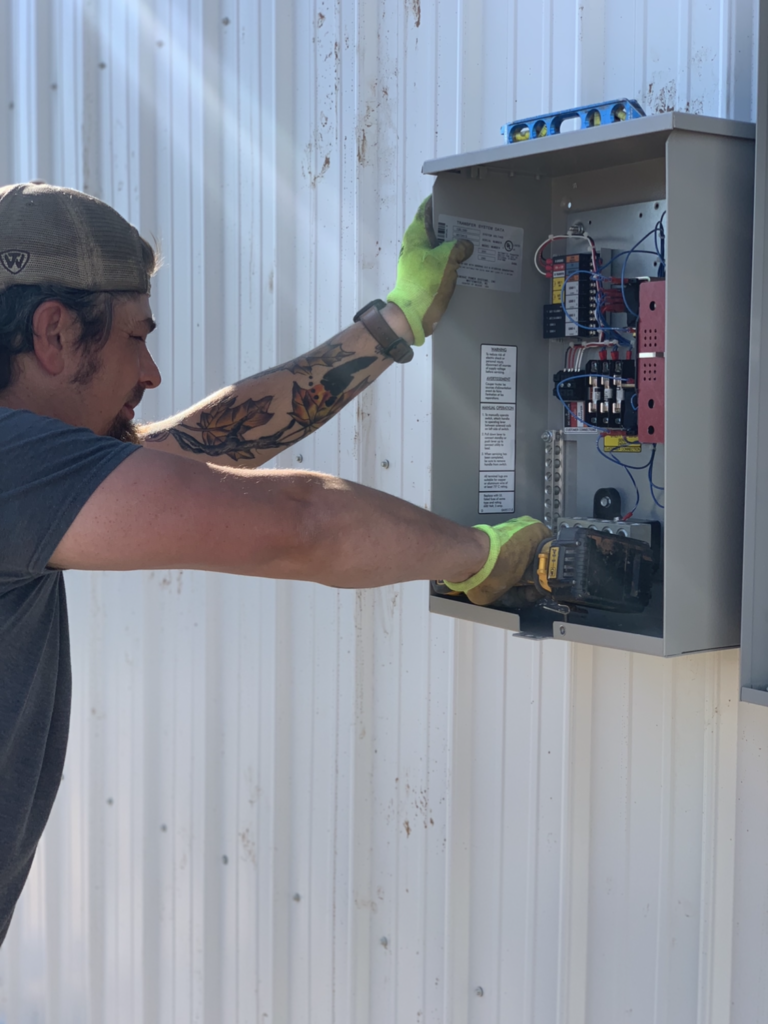
Extension Cords and Power Strips That Cause Space Heater Electrical Fires
Every space heater manufacturer prints the same warning on the appliance and in the manual, and it is the single most ignored instruction in American homes: plug the heater directly into a wall outlet and never use an extension cord or power strip. That warning exists because cord sets are built to a completely different standard than permanent building wiring. A typical household extension cord uses 16 gauge conductors rated for roughly 13 amps under ideal conditions, and the thin brown cords sold for lamps are often 18 gauge with a rating closer to 10 amps. Running a 12.5 amp heater through an 18 gauge cord loads that copper past its limit for the entire time the heater operates. The cord will feel warm, then hot, and the plastic insulation slowly softens and degrades until the conductors inside make contact or the cord ignites the carpet it is lying on.
Power strips introduce a second failure point that is even less forgiving than the cord itself. The internal bus bars and receptacle contacts inside an inexpensive strip are thin stamped metal, and they were designed for the modest loads of computers, chargers, and lamps. Pushing a sustained heater load through those contacts creates resistance heating right at the point where the plug blades meet the strip, which is why so many burned power strips show scorching around one specific outlet rather than uniform damage. The surge protection components packed into many strips add heat sensitive parts to that same enclosure. Placing the strip under a desk, behind furniture, or beneath a rug traps that heat with no path to escape. Fires that start this way often begin hours after the household has gone to sleep, which is precisely why they turn deadly so often.
Running a heater cord under a rug, across a doorway, or behind a couch creates a mechanical problem on top of the thermal one. Foot traffic crushes the conductors, furniture legs pinch the insulation, and repeated flexing at the plug end breaks individual copper strands inside the jacket. Fewer intact strands means less metal carrying the same 12.5 amps, and the remaining conductors heat up dramatically to compensate. You cannot see any of this from the outside, and a cord that looks perfectly normal can be carrying a hidden defect that has been building for two or three winters. If the heater must reach an outlet across the room, the correct answer is never a longer cord. The correct answer is a new receptacle placed where you actually need it, installed on wiring that was sized for the job.
Old Wiring and Loose Connections That Cause Space Heater Electrical Fires
Loose connections generate heat, and heat is what turns an inconvenience into a house fire. Every receptacle in your home has screw terminals or internal contacts that clamp onto a conductor, and those clamping points loosen naturally over decades of thermal cycling, vibration, and simple metal fatigue. A loose terminal creates electrical resistance at that exact spot, and resistance under a heavy heater load produces temperatures high enough to char the plastic device body and the wooden stud behind it. This is why an outlet that feels warm to the touch is never something to monitor casually. Discoloration around the slots, a faint buzzing sound, or a burning smell near the receptacle all point to the same underlying condition. Any one of those signs means the heater should be unplugged immediately and the outlet should be left alone until an electrician opens it up.
Backstabbed receptacles deserve particular attention in homes throughout Pottawatomie and Oklahoma counties. Instead of wrapping the conductor around a screw terminal, backstabbing pushes the wire straight into a small hole where a thin spring clip holds it in place. The method is fast, it was extremely common in production housing from the 1970s onward, and it produces a contact area that is a fraction of what a properly torqued screw terminal delivers. That tiny contact patch performs acceptably under light loads and fails predictably under sustained heavy ones. Space heaters find these connections faster than any other appliance in the house. When our electricians replace devices in older homes, backstabbed receptacles with visible heat damage are among the most frequent problems we document.
Aluminum branch circuit wiring adds another layer of risk in homes built roughly between 1965 and 1974, a window that covers a meaningful share of housing stock across the metro. Aluminum expands and contracts more than copper as it heats and cools, which gradually works connections loose, and the oxide layer that forms on the metal surface increases resistance at every termination. Homes with aluminum branch wiring require specific approved connectors and antioxidant compound at each device, and many were never corrected. Adding a continuous heater load to an aluminum circuit with untreated connections is one of the higher risk situations in residential electrical work. An electrician can identify aluminum conductors in minutes by pulling a single receptacle and reading the marking on the cable jacket. Not sure what is behind your walls? Click here for our electrical inspection service.
How to Prevent Electrical Fires While You Use Space Heaters This Season
Prevention breaks down into two categories, and both matter. The first category covers how you use the heater itself, which costs nothing and takes about five minutes to get right. The second category covers the condition of the wiring, outlets, and panel serving the rooms where you plan to run heat, which requires a qualified electrician but pays off across every season and every appliance in the house. Homeowners who handle only the first category are still relying on hidden infrastructure they have never verified. Handling both is what actually removes the risk rather than reducing it.
Space Heater Placement Rules That Prevent Electrical Fires
The three foot rule is the foundation of safe heater use, and it applies in every direction rather than just the front. Bedding, curtains, upholstered furniture, laundry piles, paper, and pet beds all need to stay at least three feet away from the unit on all sides. Radiant heaters throw concentrated infrared energy forward, and fabric sitting directly in that beam can reach ignition temperature without ever touching the appliance. Ceramic and oil filled models spread their heat more evenly, but their intake vents pull in air from the sides and rear, so blocking those openings causes the internal thermostat to read incorrectly and lets the housing climb past its design temperature. Give the unit clear space, and check that space again each time you move furniture or change out seasonal bedding.
Surface choice matters as much as clearance, and this is where a lot of households get careless. Heaters belong on a hard, flat, level floor rather than on carpet, a rug, a table, a shelf, or a stack of books. Carpet fibers insulate the bottom of the unit and trap heat against components that were meant to shed it into open air, and a raised surface dramatically increases the odds of a tip over. Modern heaters include a tip over shutoff switch and an overheat sensor, and those two features are the reason you should replace any unit more than about ten years old. Look for a certification mark from a recognized testing laboratory such as UL, ETL, or CSA on the nameplate, since uncertified imports sold through online marketplaces frequently lack functioning safety cutoffs. Test the tip over switch yourself by gently laying the running unit over on its side and confirming it shuts down instantly.
Supervision habits close out the placement side of prevention. Turn the heater off and unplug it any time you leave the room for an extended period, and never leave one running while the household sleeps. That advice frustrates people who bought a heater specifically to stay warm overnight, and the honest answer is that a portable heater is not the right tool for overnight heating. A properly functioning central system, a permanently installed and hardwired wall heater on its own circuit, or an improved thermostat schedule all handle that job without the risk. Keep heaters out of bathrooms and laundry rooms unless the model is specifically rated for damp locations and the receptacle carries ground fault protection. Children and pets should never have unsupervised access to a running unit, since contact burns from a heater grille happen in a fraction of a second.

Outlet and Circuit Checks That Prevent Space Heater Electrical Fires
Before the first heater comes out of storage, walk your house with a specific checklist and inspect every outlet you plan to use. Press your hand against the faceplate after a lamp has been running in that outlet for an hour and note anything warmer than room temperature. Look closely at the slots for browning, melting, or soot marks, and gently wiggle a plug to feel for looseness. A plug that falls out under its own weight indicates worn contacts inside the receptacle, and worn contacts under a heater load are a direct path to arcing. Note any two prong outlets, since an ungrounded receptacle offers no fault path and is a clear sign the branch circuit predates modern grounding requirements. Write down every location that raises a question and handle them all in one service visit rather than one at a time.
Mapping your circuits before winter is genuinely worthwhile and takes about an hour with a helper. Turn off one breaker at a time and walk the house noting which outlets and lights go dead, then label the panel directory accurately. That map tells you exactly which receptacles share a circuit, which lets you avoid the common mistake of running a heater and a microwave on the same wire without realizing it. Pay attention to bedrooms in particular, since bedroom circuits in older homes often extend much farther than homeowners assume. Once you know the layout, dedicate the lightest loaded circuit in each occupied room to the heater and keep everything else off it. This single step eliminates a large share of overload risk at no cost.
The panel itself deserves a look while you are down there. Breakers that feel warm, smell of hot plastic, or show rust and corrosion on the bus indicate problems that get worse under winter loads. Panels manufactured by Federal Pacific under the Stab Lok name and panels by Zinsco have a long documented history of breakers failing to trip under fault conditions, and both are still found in homes across central Oklahoma. Any breaker that trips repeatedly is reporting a real condition, and replacing it with a larger one is never the fix. If your panel is full, has double tapped breakers, or was installed before 1985, the safest move ahead of heating season is a professional evaluation. Want a safe circuit built specifically for a heater or other heavy appliance? Click here for our dedicated circuit installation service.
Smoke Alarms and Breaker Upgrades That Prevent Space Heater Electrical Fires
Working smoke alarms do not prevent a fire from starting, and they remain the single most effective thing standing between a small fire and a fatality. Current standards call for an alarm inside every sleeping room, one outside each sleeping area, and at least one on every level of the home including the basement. Photoelectric sensors respond faster to the smoldering, slow burning fires that electrical faults and overheated cords typically produce, which makes them the better choice for this specific hazard. Test every unit with the button monthly, replace batteries at least once a year, and replace the entire alarm once it passes ten years from its manufacture date printed on the back. Interconnected alarms that all sound together give sleeping occupants far more time to react, and that time is what saves lives when a fire starts in a distant room.
Arc fault circuit interrupter protection addresses the exact failure mode that space heaters create. An AFCI breaker monitors the electrical waveform for the distinctive signature of arcing produced by damaged cords, loose terminals, and pinched conductors, and it opens the circuit before that arc has a chance to ignite surrounding material. Modern electrical code requires AFCI protection on the majority of 15 and 20 amp circuits serving living areas in new residential construction, including bedrooms, living rooms, dens, hallways, and closets. Most homes built before the early 2000s have none of this protection anywhere in the panel. Adding AFCI breakers to bedroom and living area circuits is one of the highest value safety upgrades available to an older home, and in most panels it is a straightforward replacement.
Ground fault protection covers the other half of the picture in wet and damp spaces. GFCI devices monitor for current leaving the circuit through an unintended path, and they shut down in milliseconds when that happens. Bathrooms, kitchens, laundry rooms, garages, unfinished basements, crawl spaces, and all exterior receptacles need this protection, and any heater used in those areas depends on it. Homeowners frequently discover during a winter inspection that the garage outlets they use for a workshop heater have no ground fault protection at all. Combination AFCI and GFCI breakers handle both functions from the panel and cover the entire branch circuit rather than a single outlet location. An electrician can determine which circuits need which type of protection and complete the work in a single visit before cold weather arrives.
Why You Need a Licensed Electrician Before Space Heater Season Starts
Almost every space heater fire is the outcome of two conditions overlapping: a heavy continuous load and a wiring system that was never verified. You control the first condition through the habits described above. The second condition requires someone qualified to open devices, test connections, read the panel, and tell you plainly what needs attention. Late summer and early fall are the ideal window for that work, since schedules are open and repairs get finished long before the first freeze. Waiting until a January cold snap means competing with everyone else who waited too.
Why an Electrical Inspection Comes First Before Space Heater Season Starts
A thorough inspection gives you facts instead of assumptions about the system carrying power through your walls. Our electricians check panel condition and breaker sizing, test receptacles for correct polarity and grounding, look for scorching and heat damage at devices, evaluate conductor type and gauge, and identify circuits that are already loaded near their limit. That process turns a vague worry into a specific, prioritized list you can act on. Homeowners regularly learn during these visits that a room they treat as ordinary is fed by a circuit stretched across three other rooms.
The findings from an inspection also shape how you use heat all winter long. Knowing that your master bedroom shares a circuit with the hallway and both closets changes where you place a heater and what else you leave plugged in. Knowing that your garage receptacles lack ground fault protection changes what you run out there during a cold week. Information like this costs very little to gather and prevents decisions that lead to real damage. It also documents the condition of your home for insurance and resale purposes.
Timing an inspection before heating season means any needed repairs happen on your schedule rather than during an emergency. Replacing worn receptacles, correcting loose terminations, adding AFCI protection, or installing a dedicated circuit are all routine jobs when they are planned. The same work performed at nine at night in the middle of an ice storm costs more and takes longer. Homes in McLoud, Shawnee, Tecumseh, Harrah, and the surrounding communities all benefit from the same simple sequence of inspect, repair, then heat. Ready to get ahead of it? Click here for our electrical inspection service.

Why Dedicated Circuits Beat Extension Cords Before Space Heater Season Starts
A dedicated circuit runs from its own breaker in the panel to a single receptacle, with no other outlets, lights, or appliances sharing the wire. That arrangement gives a heavy appliance the full rated capacity of the conductor and eliminates the guessing game about what else might be drawing power at the same moment. For any space that needs supplemental heat every winter, a dedicated 20 amp circuit at the right location solves the problem permanently. It also serves you well long after the heater is put away, since the same circuit supports a window air conditioner, a workshop tool, or a home office setup.
Installation is far less disruptive than most homeowners expect. Our electricians route new cable through attic space, crawl space, or an unfinished wall cavity, install the receptacle exactly where you want it, and land a properly sized breaker with the correct protection at the panel. Most single circuit installations finish in a few hours. The work is done to code, it is documented, and it removes the extension cord from the equation entirely.
Some situations call for a step beyond a single circuit. Panels that are already full, homes still running a 100 amp service, and additions that were wired by tapping existing circuits all need capacity added before new loads make sense. In those cases a service upgrade or a subpanel is the honest recommendation, and we will tell you that directly rather than stacking more load onto a system that cannot support it. Need more capacity at the panel? Click here for our electrical panel installation service.
Why Choose 24/7 Electrical Services and Repairs Before Space Heater Season Starts
24/7 Electrical Services and Repairs is a locally owned, family operated company serving McLoud and the surrounding Oklahoma communities under Oklahoma electrician license number 084623. We give free local estimates with honest, upfront pricing, so you know the cost before any work begins and there are no surprises when the invoice arrives. Our team specializes in panel upgrades and Generac generator installation, and we handle the full range of residential and commercial electrical work. Every job we complete is backed by a one year labor warranty and a three year panel warranty. That commitment reflects how we approach the work in the first place.
Electrical problems do not schedule themselves around business hours, which is why we answer emergency calls around the clock. A warm outlet, a burning smell, a breaker that will not reset, or a heater that scorched a receptacle are all situations that need attention immediately rather than next Tuesday. We arrive prepared to diagnose the actual cause instead of applying a temporary patch. Our electricians explain what they find in plain language and give you options at different price points.
Getting your home ready for space heater season is one of the simplest ways to protect your family, and it starts with a conversation. Call us at (405) 915-3280 to schedule an inspection, discuss a dedicated circuit, or ask about a panel upgrade before the first cold front arrives. You can also reach Jonathan directly at jonathan@247electricalservices.com with questions about your specific situation. If you smell burning, see sparking, or find a hot outlet right now, do not wait for morning; click here for our emergency electrician service and call us immediately at (405) 915-3280.