
Why Your Kitchen Circuits Struggle During Thanksgiving Cooking
Thanksgiving asks more from a kitchen than any other day on the calendar. On a normal Tuesday, a coffee maker and a microwave might be the heaviest things running at once, but on the fourth Thursday in November your countertops fill up with a roaster oven, an air fryer, a griddle, a slow cooker, a stand mixer, and a second coffee pot going for guests. All of that equipment converts electricity into heat, and heat producing appliances are the hungriest loads in any home. The wiring behind your walls has a fixed capacity that does not expand for the holidays, so the demand runs into a hard ceiling and the breaker does its job by shutting the circuit off. Homeowners across McLoud, Shawnee, Norman, and Oklahoma City call our office every November with the same story about a tripped breaker at the worst possible moment. The good news is that this problem is predictable, measurable, and fixable well before the turkey goes in. Understanding how kitchen circuits carry load will tell you exactly why yours struggles and what it would take to give your kitchen the capacity it actually needs.
What Causes Kitchen Circuits to Overload During Thanksgiving Cooking
A kitchen circuit is not a bottomless supply of power; it is a specific wire size protected by a specific breaker, and both of those numbers set a firm limit. Most modern kitchens are served by at least two 20 amp small appliance branch circuits that feed the countertop receptacles, plus separate circuits for the dishwasher, the disposal, the microwave, the refrigerator, and the range. Homes built before those requirements took hold often have far fewer circuits serving the same countertop space, and in some cases a single 15 amp circuit covers the entire room. When you add up the wattage of holiday cooking equipment, the total climbs past the rating of that wire in a hurry. Breakers are designed to interrupt the flow before the conductors overheat, so a trip is a safety feature working correctly rather than a defect. The real question is not why the breaker tripped but why the demand outgrew the circuit in the first place. Once you see the arithmetic, the pattern behind every Thanksgiving outage becomes obvious.
How Kitchen Circuit Load Adds Up on Thanksgiving Morning
Electrical capacity comes down to a simple calculation that anyone can follow at the kitchen table. A 20 amp circuit operating at 120 volts can deliver roughly 2,400 watts at its absolute maximum, and the safe continuous working limit sits near 1,920 watts because code allows only 80 percent of the rating for loads that run for three hours or more. A 15 amp circuit gives you about 1,800 watts total and a continuous limit closer to 1,440 watts. Those numbers sound generous until you look at what actually sits on a holiday countertop. Every receptacle on that circuit shares the same pool of capacity, and the circuit does not care how many outlets you spread the appliances across. Two outlets on opposite walls frequently trace back to the same breaker, which surprises most homeowners. Load is determined by the wire and the breaker, never by the number of places you can plug something in.
Now look at the appliances themselves and the picture sharpens considerably. An electric roaster oven pulls somewhere between 1,400 and 1,650 watts while it heats, an air fryer typically draws 1,500 to 1,800 watts, and a countertop griddle sits right around 1,500 watts. A standard drip coffee maker runs 900 to 1,500 watts during its brew cycle, a four slice toaster lands near 1,400 watts, and a countertop microwave that advertises 1,000 watts of cooking power actually pulls closer to 1,500 watts from the wall. Slow cookers and warming trays are the polite guests of the group at 200 to 300 watts apiece, though several of them together still add up. Put a roaster and an air fryer on the same 20 amp circuit and you have already exceeded the safe limit before anyone plugs in the mixer. That is the entire mechanism behind the Thanksgiving trip, and it happens in thousands of Oklahoma kitchens on the same morning.
Breakers also respond to time, not just to a single instant of current, which explains why the failure often waits until the middle of the meal. A thermal magnetic breaker uses a metal strip that bends as it heats, so a modest overload takes several minutes to build enough heat to open the contacts. Your circuit might carry 22 amps for a while without complaint, then trip suddenly once the internal temperature reaches its threshold. Motor driven appliances such as mixers and disposals also draw a brief inrush current at startup that can be several times their running load. Add that surge on top of an already loaded circuit and the breaker opens immediately. Repeated cycles of overheating and cooling wear out the breaker mechanism over time, which is why a circuit that trips every holiday eventually starts tripping in July as well. A breaker that has been abused this way loses calibration and needs replacement by a licensed electrician.
Why Older Kitchen Circuits Struggle More Than New Ones
Housing stock around McLoud, Tecumseh, Harrah, and Del City spans many decades, and the wiring in each era reflects the appliances people owned at the time. A kitchen wired in 1965 was designed for a refrigerator, a range, a percolator, and maybe a toaster, because dishwashers were uncommon and countertop cooking equipment barely existed. Builders ran the minimum number of circuits allowed, sized the service panel for a much smaller total load, and never anticipated an induction cooktop or a second refrigerator in the garage. Those original circuits remain in service today, feeding a kitchen full of equipment that would have seemed like science fiction to the original electrician. The wire has not degraded in most cases, but the demand placed on it has multiplied several times over. This is capacity mismatch rather than defective work, and it is the single most common reason older kitchens struggle in November.
The connections inside those older circuits create a second layer of problems that shows up under heavy load. Many homes built between roughly 1965 and 1973 used aluminum branch circuit wiring, which expands and contracts more than copper and can loosen at terminals over the years. Loose connections generate heat and resistance exactly when current is highest, which means the holidays are when they announce themselves. Receptacles wired through the push in holes on the back rather than the screw terminals on the side develop the same weakness, since those small internal contacts carry the full current of everything downstream. Decades of plugging and unplugging also wear out the internal contacts of an outlet until the blades of a plug no longer grip firmly. A receptacle that feels loose or warm is telling you that resistance is building at that point in the circuit. Any of these conditions can turn an ordinary overload into a genuine fire hazard.
Panel capacity sets the outer boundary on everything else you might do. A 60 amp or 100 amp service was standard for years and worked fine for the loads of that era, but a modern kitchen combined with central air conditioning, an electric water heater, and a clothes dryer can exhaust that supply. Older panels also fill up physically, leaving no open spaces to add the new circuits a kitchen needs. Certain brands, including Federal Pacific and Zinsco, have documented histories of breakers that fail to trip under overload conditions, and those panels should be replaced regardless of holiday cooking. Insurance carriers in Oklahoma increasingly ask about panel brand and service size during underwriting. Upgrading the service is often the first step that makes every other kitchen improvement possible. Our team handles that work regularly for homeowners who want capacity in place before the busy season arrives.
Kitchen Circuit Warning Signs You Should Notice Before Thanksgiving
Your kitchen usually gives several weeks of notice before a circuit fails outright. Lights that dim briefly when the refrigerator compressor starts, or when the microwave kicks on, indicate voltage drop from a circuit working near its limit. A slight flicker once in a while is normal on a shared circuit, but a noticeable dip that repeats every time a specific appliance runs deserves attention. Outlets that feel warm to the touch are never acceptable, since a properly functioning connection stays at room temperature even under load. Discoloration around the slots of a receptacle, or a faint brown tint on the cover plate, points to heat that has already been building for some time. A buzzing or crackling sound from a switch, an outlet, or the panel itself means arcing is occurring inside the device. Any burning smell in the kitchen with no food source should send you to the panel immediately.
Repeated breaker trips deserve a different response than most homeowners give them. Resetting the same breaker two or three times a week is not a maintenance routine; it is a signal that the circuit cannot support what you are asking of it. A breaker that feels hot, refuses to reset, or resets and trips again within seconds indicates a fault rather than a simple overload. Ground fault protection adds another dimension in the kitchen, since GFCI devices monitor for current leaking outside the intended path and trip at very small imbalances. Recent code cycles require ground fault protection on essentially every kitchen receptacle, including the ones serving the dishwasher and the range. A GFCI that trips repeatedly with a specific appliance plugged in is often detecting a failing heating element or a damaged cord. Arc fault protection, required in kitchens for several code cycles now, responds to the signature of arcing rather than to current level.
Timing your response matters more than most people expect. Electricians across central Oklahoma see their heaviest residential call volume in the two weeks before Thanksgiving and the two weeks before Christmas, so scheduling in October gives you far more flexibility. An evaluation of your kitchen circuits takes a couple of hours and tells you precisely which receptacles share which breakers, how much capacity remains, and what a safe layout looks like for holiday cooking. That information alone prevents most seasonal trips, even without any new wiring. If the evaluation shows you need more capacity, you still have time to complete the work on a normal schedule at a normal price. Need more outlets and capacity where your holiday appliances actually sit? Click here for our dedicated circuit installation service. Getting ahead of the season is far easier than reacting to a dark kitchen with company in the dining room.
How to Prevent Kitchen Circuit Problems Before Thanksgiving Dinner
Preventing a holiday overload comes down to two strategies working together: manage the load you have, and add capacity where the load has permanently outgrown the wiring. Load management costs nothing and solves a surprising number of cases, since most kitchens have more circuits available than the homeowner realizes. Mapping which outlet belongs to which breaker turns guesswork into a plan you can hand to whoever is helping with the cooking. Capacity additions handle the situations where arithmetic simply will not cooperate, such as a kitchen with one 15 amp circuit serving eight feet of countertop. New dedicated circuits, panel space, and service upgrades all fall into that second category and require a licensed electrician. Extension cords and power strips belong in neither category, because they add length and resistance without adding a single amp of capacity. The right combination depends on your home, your panel, and how you actually cook.
Spreading Appliances Across Kitchen Circuits the Right Way
Start by mapping your kitchen circuits on a quiet afternoon well before the holiday. Turn off one breaker at a time and walk the kitchen with a lamp or a receptacle tester to find every outlet that goes dead. Write the breaker number on a piece of tape inside each cabinet near the corresponding outlet, or keep a simple sketch on the refrigerator. You will likely discover that the two outlets flanking the sink belong to different circuits while two outlets on the same wall share one. Include the dining room and any adjacent counter space in your map, since those receptacles are sometimes fed from the same small appliance circuits. This exercise takes about an hour and pays for itself the first time it prevents a trip. Keep the map somewhere you can find it next year.
With the map in hand, assign your heaviest appliances to separate circuits before you plug anything in. Group the big heat producers so that no single circuit carries more than one of them at a time, since a roaster, an air fryer, and a griddle each consume most of a 20 amp circuit on their own. Pair a high draw appliance with low draw companions such as a slow cooker, a warming tray, or a stand mixer to stay within safe limits. The refrigerator deserves special protection, because a tripped breaker on that circuit can go unnoticed for hours and put your food at risk. Never run a roaster oven or a griddle from the same circuit as the refrigerator. If your dining room outlets come from a different breaker, that is an excellent place to set up a coffee station or a warming area. Moving one appliance twelve feet can be the difference between a smooth meal and a dark kitchen.
Extension cords and power strips deserve a direct warning, since they cause a meaningful share of holiday kitchen fires. A power strip does not create capacity; it simply gives you more places to connect to a circuit that already has a fixed limit. Light gauge extension cords, particularly the flat brown ones sold for lamps, cannot safely carry 1,500 watts and will heat up along their entire length. Cords run under rugs or across doorways trap that heat and add a trip hazard in a room full of people carrying hot dishes. Daisy chaining one strip into another compounds every one of these problems. If you must use a cord temporarily, choose a heavy 12 gauge model rated for the appliance and keep it short and visible. The permanent solution is a properly placed receptacle on a circuit sized for the work, and that is a straightforward installation for a licensed electrician.
Adding Dedicated Kitchen Circuits for Heavy Holiday Appliances
A dedicated circuit serves exactly one appliance or one receptacle and shares its capacity with nothing else. Code already requires this arrangement for several kitchen appliances, including the dishwasher, the garbage disposal, and in most installations the microwave and the refrigerator. Homeowners who cook seriously often benefit from one or two additional dedicated 20 amp circuits placed where the holiday equipment actually sits. A dedicated circuit at the end of the counter, or on an island, gives a roaster oven or an air fryer the full 2,400 watts of a 20 amp branch without competition. That single change resolves the majority of seasonal trips we see in homes that otherwise have adequate service. The cost is modest compared to a full kitchen renovation and the benefit lasts for the life of the house.
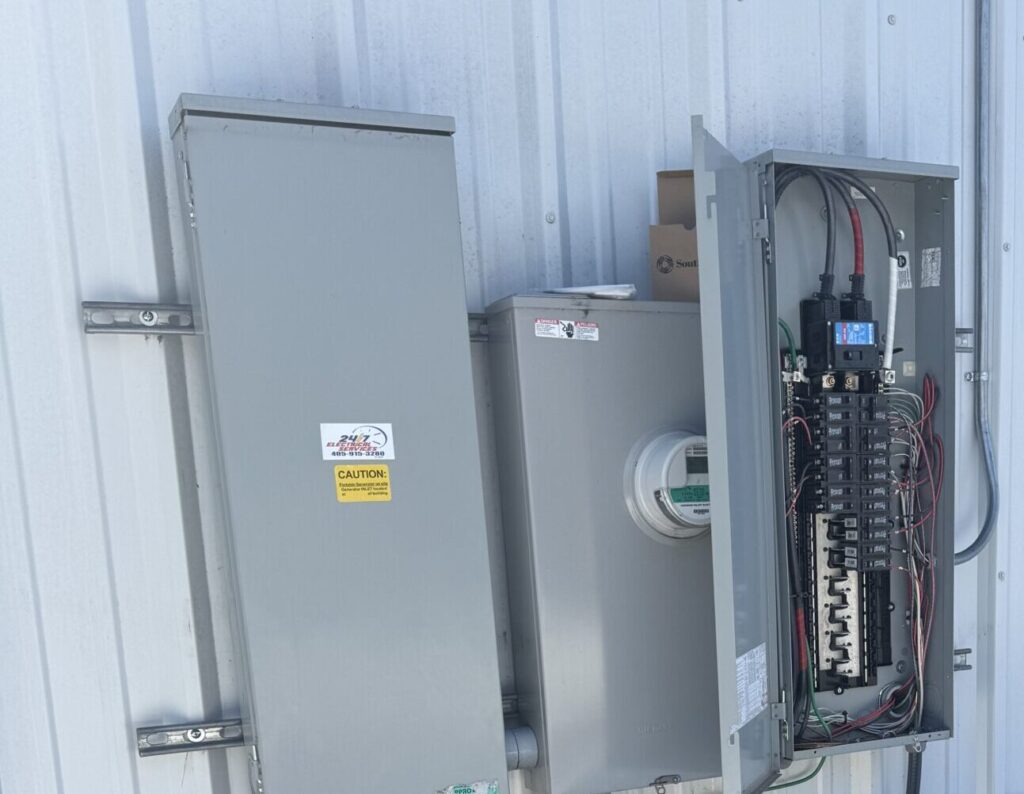
The installation itself is more involved than adding an outlet to an existing circuit, which is precisely why it works. A new dedicated circuit requires a fresh run of 12 gauge copper from an available space in the panel to the new receptacle location, along with a new 20 amp breaker with the required ground fault and arc fault protection. Routing that cable through finished walls takes skill, and the path has to respect framing, insulation, plumbing, and existing wiring. Every kitchen receptacle installed today needs ground fault protection, and the device or breaker has to be selected and wired accordingly. Permits and inspection apply in most jurisdictions in our service area, which protects you at resale and with your insurance carrier. This is not a task for a weekend project, and Oklahoma licensing requirements exist for good reason.
Where you place those circuits matters as much as the fact that you added them. Think about where your family actually works during a big meal rather than where the builder happened to put outlets. Islands and peninsulas frequently host the roaster and the air fryer, and receptacles serving those surfaces have specific code requirements for placement and protection. A dedicated circuit near the coffee station keeps a 1,500 watt brewer from competing with the toaster every morning of the year, not just in November. Some homeowners add a 240 volt circuit at the same time for a future induction range or a second wall oven, since the labor overlaps. Planning for the next ten years costs very little more than planning for this Thursday. Want to know how many amps your appliances really need? Click here for our electrical panel installation service.
Kitchen Circuit Upgrades That Support a Modern Holiday Kitchen
Sometimes the kitchen circuits are only a symptom and the panel is the real constraint. A 100 amp service that supports a heat pump, an electric water heater, a dryer, and a full kitchen has very little headroom left for anything new. Adding circuits to a panel with no open spaces requires either tandem breakers where the panel permits them, a subpanel, or a full service upgrade to 200 amps. A licensed electrician performs a load calculation using the methods in the National Electrical Code to determine which path fits your home. That calculation accounts for square footage, fixed appliances, heating and cooling equipment, and the demand factors code allows. The result is a number, not an opinion, and it tells you exactly what your home can support.
A service upgrade brings benefits well beyond holiday cooking. New panels have more spaces for future circuits, modern breakers with current protective features, and proper grounding and bonding that older installations sometimes lack. Homeowners adding an electric vehicle charger, a hot tub, a shop in the garage, or a standby generator all need panel capacity, and doing that work once instead of three times saves money. Insurance companies in Oklahoma frequently ask about panel age and brand, and some decline coverage on certain older equipment entirely. Appraisers and home inspectors note service size during a sale, so the upgrade holds value. The work usually takes one day with a coordinated utility disconnect.
Whole house surge protection deserves a place in this conversation as well. Oklahoma weather produces frequent lightning activity and utility switching events that send voltage spikes through branch circuits. Modern kitchens are full of electronics, from refrigerator control boards to induction cooktops to smart ovens, and each of those boards costs far more to replace than a surge device costs to install. A panel mounted surge protective device clamps those spikes before they reach your appliances and works alongside point of use protection at sensitive equipment. Grounding and bonding have to be correct for that device to function, which is another reason a professional evaluation matters. The combination of adequate capacity, correct protection, and sound connections is what makes a kitchen dependable under holiday load.
Why You Need a Licensed Electrician for Kitchen Circuit Repairs Before the Holidays
Kitchen wiring sits at the intersection of high current, water, heat, and constant use, which is why code treats it more strictly than almost any other room in the house. Ground fault protection, arc fault protection, dedicated circuit requirements, and receptacle spacing rules all apply, and each one exists because of documented injuries and fires. A licensed electrician knows those requirements, pulls the required permits, and leaves you with an installation that passes inspection and holds up under real use. Guesswork in this room carries consequences that show up as scorched receptacles or worse. Our licensed team works throughout McLoud, Shawnee, Norman, Oklahoma City, Edmond, Moore, Yukon, and the surrounding communities on exactly these projects. Getting the evaluation done now keeps your holiday about the food instead of the breaker panel.
What a Licensed Electrician Checks During a Kitchen Circuit Inspection
An evaluation of your kitchen circuits starts at the panel and works outward. We identify the service size, check the panel brand and condition, look at available spaces, and verify that grounding and bonding are correct. Each breaker gets tested and traced so we can document which receptacles and appliances belong to which circuit. We measure actual voltage and check for drop under load rather than relying on assumptions about how the house was wired. That documentation becomes a map you can use every year.
At the receptacles, we look for the conditions that create heat and resistance. Loose terminals, back wired connections, worn contacts, missing or failed ground fault protection, and damaged devices all show up during a hands on inspection. We check that countertop receptacle spacing meets current requirements and that island and peninsula surfaces are served correctly. Any device showing discoloration, warmth, or a loose grip gets replaced rather than reused. Small corrections here often eliminate problems that had been blamed on the breaker.
The final step is a load review that connects the findings to how you actually cook. We add up your fixed appliances, review your countertop equipment, and calculate what each circuit can safely carry. From there we recommend a plan, which might be as simple as a revised appliance layout or as involved as new dedicated circuits and a service upgrade. You receive honest, upfront pricing before any work begins, with no pressure to buy more than the situation requires. Want your kitchen checked before the guests arrive? Click here for our electrical inspection service.
When Kitchen Circuit Problems Become an Emergency Electrical Call
Certain symptoms should never wait for a scheduled appointment. A burning smell, visible smoke, sparking from an outlet or switch, or a receptacle that has scorched its cover plate all call for immediate action. Turn off the affected breaker if you can reach the panel safely and call for help right away. Do not reset a breaker that trips instantly or feels hot in your hand, because that behavior indicates a short circuit or ground fault rather than a simple overload.
Other situations qualify as emergencies because of what they threaten. Losing power to the circuit that feeds your refrigerator on a holiday weekend puts hundreds of dollars of food at risk. A panel that hums, smells hot, or shows any sign of corrosion needs attention before it fails completely. Partial power loss across the house, where some circuits work and others do not, often points to a failing service connection or an open neutral that can damage appliances.
We answer emergency calls around the clock, holidays included, because electrical failures do not respect a calendar. A technician can isolate the fault, restore safe power where possible, and make permanent repairs once the immediate danger has passed. Having a number to call takes a great deal of pressure off a bad situation. Facing a live electrical problem right now? Click here for our emergency electrician service.
Why Choose Our Business for Your Kitchen Circuits
24/7 Electrical Services and Repairs is a locally owned, family operated company serving central Oklahoma with licensed work under Oklahoma license number 084623. We live in these communities, we know the housing stock, and we understand the wiring practices common to each era of construction around McLoud, Shawnee, and the Oklahoma City metro. Our estimates are free and local, our pricing is honest and upfront, and we explain what we found in language that makes sense. You will never get a quote for work your home does not need.
Panel upgrades and dedicated circuits are core parts of what we do, along with Generac generator installation for homeowners who want power through an ice storm or a summer outage. Our work is backed by a one year labor warranty and a three year warranty on panels, which reflects the standard we hold ourselves to on every job. We pull permits, follow current code, and leave the site clean. Emergency service is available around the clock, every day of the year.
The best time to address kitchen circuit capacity is right now, several weeks ahead of the holiday cooking season, while scheduling is open and the work can proceed at a normal pace. A short evaluation this month can prevent a tripped breaker in the middle of Thanksgiving dinner and give you a kitchen that handles anything you ask of it. Call 24/7 Electrical Services and Repairs at (405) 915-3280 to schedule your free local estimate, and let us put the right capacity behind your countertops before the roaster comes out of the closet.